06 August 2017

Be Like Stella (Get Your Groove Back)


I remember June 2011. I was attending my WeightWatchers class (the gods bless WW! My WW journey was incredible, by the way) when, during our talks, a wonderful 50-something year old woman said that she was waiting on the final 2lb before her daughter’s wedding. She’d lost about 40lb, but the 2lb just wasn’t moving. It hadn’t moved in over a month, and her daughter’s wedding was 2 weeks away, if my memory serves me well. Just a week to her daughter’s big day, guess what happened? It moved! Finally! It was emotional, inspiring, and super exciting. This same plateau feeling we all reach after a period of consistent progress is normal. Those who win are the persistent ones. You can win, too.

Although I would not recommend being a slave to the scale/numbers, using the scale does have its occasional advantages.  It can give you an idea of how you’re doing, especially if you don’t strength train. There have been times (and recent times indeed) when I needed to be Stella – certainly needed my groove back! Most times, I’ve gotten it back. Let’s talk some ways I’ve made my honesty dress budge: shrinking a bit more and doing it healthily, happily, and most importantly, sustainably.  For the record, progress is a slow process (50 cent was the man). Even if you feel as though you’re not making much progress, remember that sustainable weight loss takes time. Here are my tips to switching things up to make progress.

1.     Hold on, you’re most likely making progress
Don’t despair just yet.  Your body is not trying to work against you. You live in your body, and your body is working for you. Be easy on your body. Take a minute to appreciate it, and the work it’s done thus far. Because you aren’t noticing more changes over a few weeks does not mean that you’re doing anything wrongly. Our bodies adjust, recuperate, might need a break, or might just need more time to adjust to a new environment. If you are still doing everything right, you have to trust the process. You’ll be happier for it.
2.     Diversify your food portfolio
Sounds like I’m referring to some trust fund here. I mean, we are our bodies’ trustees, right? We’re the ones entrusted with this frame that should last us a good number of years. Variety is the spice of life. Switch up your food a little. If you’ve been having a protein-focused breakfast, why not try one that includes complex carbohydrates, for example? Or if you eat leafy salads for dinner, why not try a more wholesome salad with seeds, legumes, cruciferous veggies and perhaps a yogurt-based dressing that you’ve never made? I made this wonderful yogurt based dressing to match my salad yesterday and it was so yum! I can share the recipe if you’d like J. Also speaking of diversifying, try reducing your animal flesh. I know a lot of us get our protein from chicken, beef, fish, lamb etc., but switching it up is always nice. Try a day without animal flesh. Go for legumes, eggs, almonds, Greek yogurt and so on. Constant consumption of animal flesh without giving your body a break might leave you feeling bloated – a recipe for false ‘weight gain.’
3.     Diversify your workout portfolio
Especially for runners, this is a tall order. Runners are so obsessed with logging in miles, that doing any other thing is considered sacrilege if we haven’t ‘paid our dues.’ But even within running, it’s possible to diversify. Interval training, speed workouts, shorter runs with time to spare for weight lifting, etc. If you’re not a runner, why don’t you try something different? Get a workout buddy. Try yoga. Workout at a different time of the day. Add an extra day in. Join a group exercise class. Do a workout challenge. Buy new workout clothes that’ll make you want to do more (I love this one).
4.     Watch your sodium intake
For my scale addicts, sodium can literally take a 160lb person to 165lb the next morning. Don’t panic, just adjust your sodium intake and drink more water. There are also hidden salts in foods that we don’t notice.
5.     Snackers beware
I have an entire post on snacking here. If you snack, you have to be really careful when you’re stuck in a rut and the weight just isn’t shifting. Switch your snacks. Eat some carrots and cucumbers, if you must snack. Pick up a few pieces of almonds – yes, almonds have calories, but not all calories are equal. The fullness from almonds can keep you full for a few hours and still provide you with fibre, protein, healthy fats, and so much more! These snacking methods are 100% sustainable. We are all about sustainability at themeasuringcupblog!

Share your thoughts with your friends and me. Till next time,


anu

23 October 2016

Is it Healthy, or is it Hell-Worthy?


You know how you weave through the aisles during lunch hour looking for the 'healthiest' option? Well, sometimes, what you think is 'healthy' is really just hell-worthy (not exactly the best pun, but you know what I mean).

So, Pepsi has just been sued (not the first time) for making their juices seem healthier than they are. Those “naked” juices, marketed to be “healthy,” are packed with more sugars than if you drank a can of Pepsi/Coke. Imagine that.

http://www.businessinsider.com/pepsico-sued-for-naked-juice-marketing-2016-10
I am not surprised. I have a rule of thumb: I barely do liquid calories that I didn’t prepare myself. I did a blog post on juices a while back and many of my readers had been substituting fizz for juices in the hopes that the juices were healthier. Now, whilst the juices may have a ton more vitamin C, antioxidants and the like, you are better off buying your own fruit than purchasing a blended mix from the shelf.

Here are some tips for buying calories marketed to be ‘healthier’ if you are seeking weight loss and are on a ‘diet’*. You probably know by now that I am all about a portion-controlled diet as opposed to a calorie-focused diet.


  •  When buying items that say “healthy,” take a closer look. Often times, ‘healthy’ items proclaim to have less fat that the unhealthy items and compensate less fat for more sugar.  In other instances, the “low sodium” items are just diluted with water – you’re better off buying regular soy sauce and using a little, than wasting your resources on low sodium soy sauce. Also, low fat muffins often contain more sugar than full-fat muffins. Plus, if you’re gonna eat a muffin, please eat a damn muffin and enjoy it – or eat half a muffin.
  • When buying “lower calorie” items, read the label.
a.     Example #1: Amstel Malta markets on the premise that it has lower sugars than other brands. Have you looked at the difference between the sugars in it and the sugars in Maltina? Give or take, there is about a 0.2g difference in sugars – which really is negligible. Also, there's barely a 20-calorie difference between Amstel and Maltina, which is way too marginal to be considered "healthier."

b.     Example # 2: My friend bought “Light Almond Milk,” and I bought “Regular Almond Milk.” Before even looking at the labels, I told her that her milk was a scam – and I was entirely right. Her milk had LESS protein, LESS potassium, and literally .5g less fat. Now, come on! Guess what? The calories were exactly the same. Marketing can be deceiving, but you have #themeasuringcupblog to do the homework on your behalf.

c.      Example # 3: Low-fat yoghurt vs. Full-fat yoghurt. This really is a thing of preference. Some low-fat yoghurts contain more calcium than full-fat yoghurts, but may contain more sugar than full-fat yoghurts. Overall, they usually contain less calories. If you love yoghurt and are trying to lose weight, I would generally avoid yoghurts that have sugars in them. A good alternative is unsweetened Greek yoghurt in controlled portions – you’ll get more protein and fewer carbohydrates than regular yoghurt.


  •        One more thing: A food item that says “diet” won’t negate calories consumed (lots of pizza with a diet coke, anyone?). In similar vein, adding a salad to an unhealthy meal changes absolutely nothing. I have encountered lots of well-meaning people who eat their creamy meals and say “well at least, it came with a salad.” Plus, coleslaw isn’t exactly a salad (goodness me – after that heap of jollof, goat meat, fried plantains. I am watching you! Lol)

My readers, please spend more time reading your labels. And if you can’t be bothered, I am more than happy to read them on your behalf!

Have a great week, all! Don’t forget to ask, share, and implement!

Till next time,

Anu


* I asterisked ‘diet’ because there is the wrong perception that ‘diet’ means a healthy, intentional diet. Actually, every human being is on a diet. Some are just healthier than others.


20 June 2016

Should You Smack the Snack Out Of Your Mouth? - My Snacking (Nigerian) Guide


Snacking is a common point of contention within diet, fitness, and weight loss circles. Should you snack? Should you not snack? All the prongs of this debate can certainly be settled and reconciled with a deeper look at what you are snacking on and why you need to snack. Snacking is sometimes unnecessary. If you equip yourself with a wholesome meal filled with complex carbohydrates, healthy fats, protein and vegetables, you’re less likely to have a craving later on (except you are hormonal or have a health challenge). On the other hand, if your meal was hinged on simple carbohydrates, saturated fats with a dash of a seeming protein, you’re probably going to need a snack a few hours after. The bottom-line on this point is this: never substitute a good meal with the hope of grabbing a snack thereafter (#the-measuringcupblognugget).

Snacking Nigerian can be healthy. It’s great that we are blessed with a wide variety of healthy snacks at very affordable prices. Whilst some are seasonal, there’s always something you can munch on in a portion-controlled quantity. I’ll give you detailed examples in a little bit.

What is a Snack?

This question is a million naira question. Ask me why? It is tricky because any food item can indeed be “snacked” on. You can snack on jollof. I’ve done it before – don’t judge me. But is it really a snack? Having two (regular eating spoons) of jollof—is it considered a meal or a snack? Alternatively, is consuming a tub of fura da nono (yoghurt with millet – Omg, super duper yum) considered as snacking? I will venture to define snacking as any meal that you do not consider a major meal, i.e. any meal that is not breakfast, lunch, or dinner.

Is Snacking Wise?

Before I give my opinion about snacking, I’ll present you with the two most common schools of thought regarding snacking in tabular form:

No Snacks
Yes Snacks
  1. Snacks are added calories
  1. Snacks can be healthy and controlled
  1. Snacking means that you did not eat a proper meal earlier.
  1. A snack might be needed after a small meal, not necessary an ‘improper’ meal
  1. Snacking is often linked to weight gain.
  1. If snacking does not include high-calorie food items, it can actually be a way to keep hunger in abeyance.
  1. Unhealthy snacks are more accessible than healthy snacks
  1. If snacks are pre-planned, they could be healthy and nutritious
  1. Snacking is a bad habit. It’s greedy.    
  1. Snacks may keep you going during the day.


My Take/ #The-MeasuringCupBlog’s Take

I will be honest- I do enjoy my snacks. However, over the years, I have found that snacks are less necessary when I’m eating right and keeping hydrated. Half the time, they’re just extra calories that add nothing to my nutrition. It would shock you that even healthy snacks are high in calories, and that your mindless consumption has added a whopping 500 calories to your 1500 calorie (weight-loss) diet! I’ve learnt to snack on a cup of tea, carrots, chewing gum, cucumbers, fruit, and foods that generally don’t carry extra calories. Put it this way: if I will be embarrassed when I look at my food log throughout the day, then I’d rather not do it. I have also noticed that my weight tends not to fluctuate when I don’t snack. I have more balance, energy, and I’m more in control of my appetite. I would advise my readers to do the same: focus on getting your healthy meals throughout the day, so that you don’t have to grab snacks that are often processed and unhealthy. #The-MeasuringCupBlogNugget - before snacking on food, have a healthy drink i.e. water, tea, coffee.

Healthy Snacks - the Nigerian Way (If you must)
If you must snack, please eat natural foods in controlled portions. They achieve what good snacking should achieve - staving off hunger and keeping you energised.

Avocado - Thankfully, avocado is excellent. It's a very healthy fat, is filling, requires not much fuss, and readily accessible. You can enjoy half an avocado (or a full one, if you've factored it into your daily intake).

Peanuts - please don’t go more than one handful of Nigerian ‘groundnuts’. Peanuts are great, but they’re high in calories. If you’re going for a caloric deficit, please watch your intake.
Roasted/Boiled corn - One ear is good enough. Remember, corn is also high in calories.
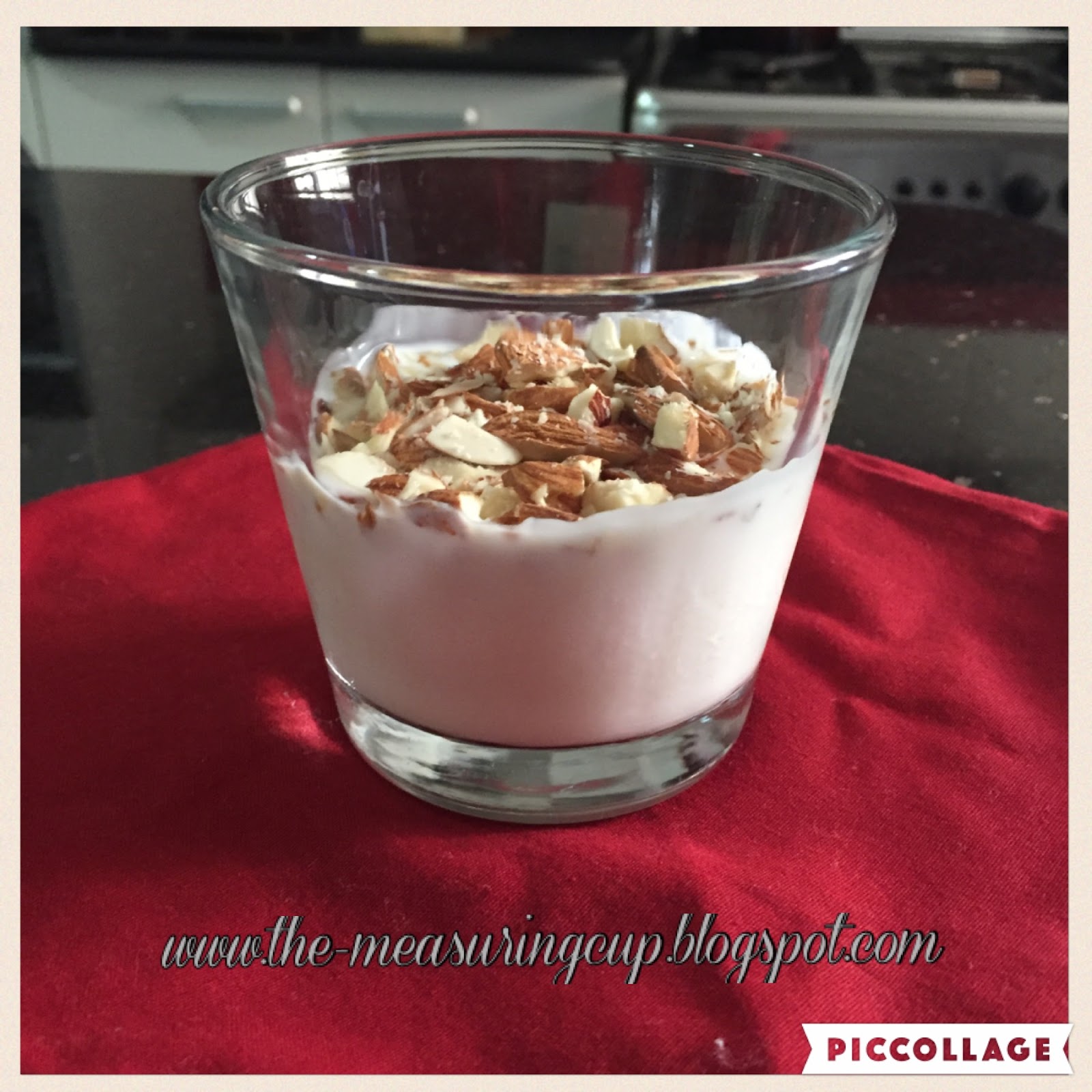
Yoghurt - as in the photo, I advise adding either fruit or crushing filling nuts like almonds (not more than 6 almonds (see photo above, where I crushed the almonds to maximise their use) if you’re on a weight loss diet) into your yoghurt. You’ll be truly satisfied.
Fruits- Enjoy your fruits whole (dreaming about cold mangoes right now, yum!). If you’re on a weight loss diet, keep your fruit to a minimum of 5 pieces  day. I also find that my fruits go a longer way when I eat them on an empty stomach. Try it.
Nigerian walnut (Asala, Ukpa, Okwe)- These are delicious and filling. I wouldn’t eat more than 3-4 on a weight loss diet.*
Tiger Nuts (fresh) - I find that the fresh ones can be tough on my teeth. However, I’ve heard you can soak them in order to make them easier on the teeth. Many people also make milk out of them. Healthy alternative to dairy for all we lactose intolerant folk.
Crackers - Nigerian made crackers are usually very low in calories. You can have a pack (contains 3 biscuits) with a cup of tea or coffee. I would advise reducing the amount of sugar and milk you use for your cuppa if you’re a frequent drinker. Otherwise, factor it into your daily intake if you’re addicted to your cuppa!
Raw coconut- Coconuts have great health benefits, including healthy fats. Try not to overdo it, but if you want a chew and it's there, please go for a controlled portion of it. Enjoy!

Nigerian Snacks to Avoid/Reduce:
Meat, chicken and fish pies
Egg rolls
Doughnuts
Sausage rolls
Gala
Puff puff
Spring rolls
Samosas
Buns
Chin-chin
Coconut candy
Sweetened tiger nuts

If you must have unhealthy snacks, try and do the following:

  1. Share the calories. Share them with a co-worker, a roommate, or split it and keep the rest somewhere that’s ‘far’ away.
  2. It’s probably just a craving, so have a little. That little bit should do the trick.
  3. Plan for it. If you know it’s a co-worker’s birthday and you’re expecting treats, skimp on your main meals to accommodate the extra calories.
  4. Think. Many times, I think about what exactly I’m putting into my body, and it helps me stay away. I imagine what exactly is in puff puff, for example, and choose to look the other way. Other times, well, I just have to have a few :)

Looking forward to your comments, ideas, and questions!

Till next time,
anu


20 April 2016

Weight-Loss Fads That You Should Give No Weight

I have a little secret that must stay between you, my precious and loyal readers, and me. I have to woo you all, because it’s been a while since I blogged. I must tender my unreserved apology. This won’t repeat itself. I owe someone very dear a meal plan, and I have other debt to my amazing readers who enjoy my posts and implement my advice. I will pay my debt and be more present. Please forgive meJ.

So, my little secret is that I was eavesdropping. I know; it’s terrible. But I was right around the corner when I heard my name being mentioned in the conversation, and I just couldn’t help but listen intently before I made my way to the other room. I heard two women (I won’t say where as it might give me away ha-ha) conversing about belly fat. A was seeking ways to reduce her belly fat with keeping the other parts of her anatomy intact. B informed A that to get a stomach like yours truly, (I’m blushing, but I’m thankful I can be used as a reference point) she should drink detox tea and within a few months, her belly would magically disappear! Wow. If only it were that easy.

Sadly, such questionable ideas are pretty common. Along with spot weight loss, there are myths about general weight loss that are not only ineffective, but are harmful to your mind and body. I want to address some fads in this post and please leave a comment if you’d like me to discuss more fads that I haven’t covered.

1.    Detox Tea Will Lose Your Belly Fat

No, detox tea will not help you burn belly fat. Here’s what detox tea will do: it will help you go to the loo lots and eject lots of water from your system. It won’t burn fat and whatever weight you lose will be water weight. However, you can use detox tea if you’re trying to look a bit more slender in a bikini or a fitted dress. But make no mistake; you haven’t achieved fat burning or a calorie deficit, which are the integral catalysts of healthy and sustainable weight loss.

2.    Green Tea Consumption Will Burn All the Food You’ve Consumed

I’ve had many instances where people around me eat their delicious semo and juicy, oily efo riro (or whatever grease infested accompaniment), then drink GT after that with the expectation that GT will automatically burn all the food consumed. This couldn’t be farther from the truth. Whilst GT will aid digestion, it won’t negate the 1,000 calorie meal you’ve had. I do encourage tea consumption because tea really does aid digestion, but not in lieu of a calorie-controlled healthy meal.

3.    Exercise at Night Will Burn all the Calories Consumed that Day

I’ve heard quite a few people make this argument. I actually think I need to conduct more research and write an entire post on this. I’m not sure if there’s an exact science for exercise times and calories burnt, but I’m pretty sure you don’t burn all the calories consumed that day because you’ve exercised in the evening. The most you can do is perhaps try to burn 2,000 calories at the gym in the evening – which is also what you can equally do in the morning (very ambitious feat, I must say). Since food isn’t physically extracted from our bodies during exercise, it is a fallacy to think you’re negating all the calories consumed that day with your workout.

4.    Drinking lemon water/apple cider vinegar (ACV) for Weight Loss

Drinking lemon water may have its benefits, but there certainly is not any direct correlation with drinking lemon water /ACV and shedding some pounds! By all means, drink lemon water because it is loaded with benefits, but don’t be disappointed if that singular lifestyle choice does not yield weight loss benefits.

Are there any weight loss ideas you’re not sure about? Drop a comment and we’ll explore them some!

Till next time,


anu